What Do Ticks Look Like? Size, Colour and Features
In short: A tick is a small, oval arachnid with eight legs (six as a larva), a hard, dark shield on its back and tiny mouthparts at the front that look like a head. Adult ticks are only 2.5 to 4.5 millimetres long, nymphs one to two. Once fully fed, a female swells to around one centimetre. Ticks have no wings and no antennae.
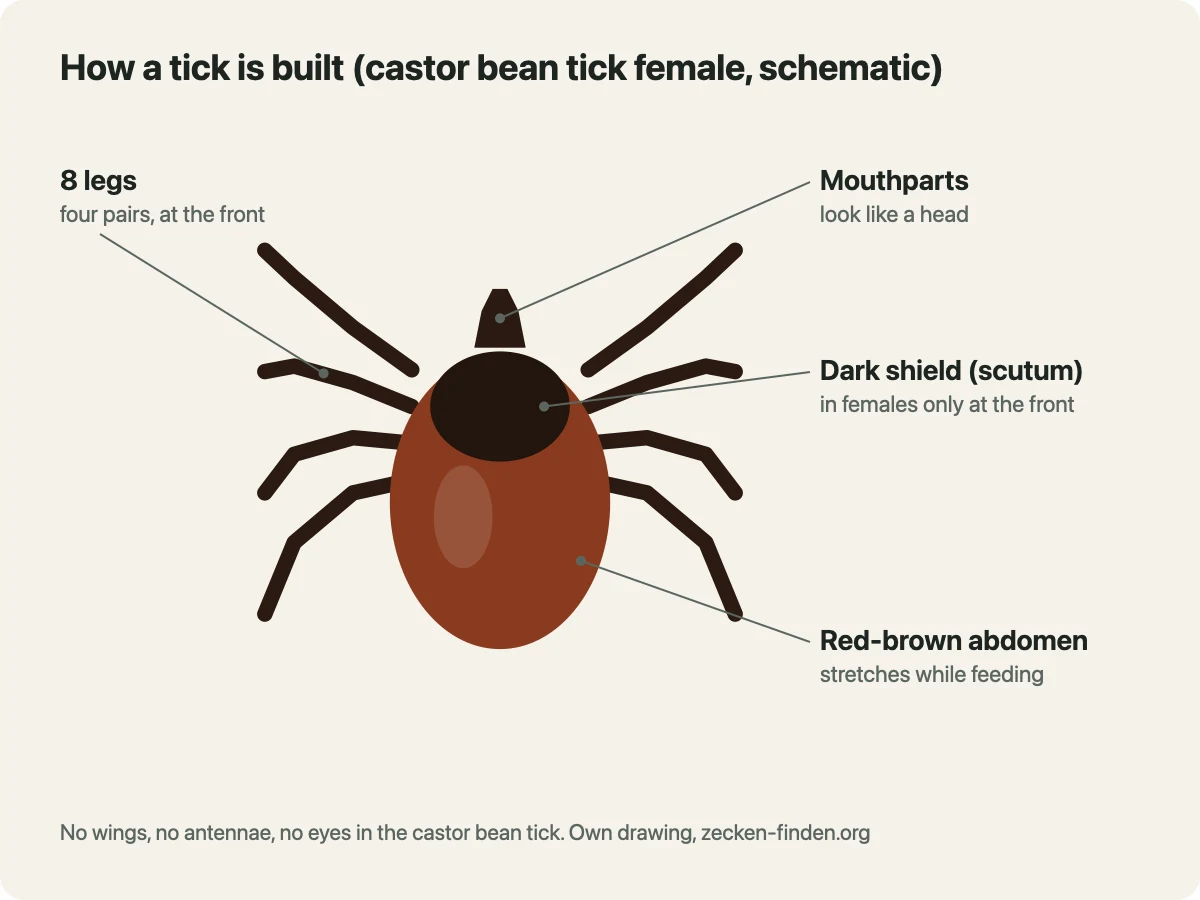
The features that identify a tick
In Germany it is almost always the castor bean tick (Ixodes ricinus). Like the ornate dog tick, it is a hard tick, and according to Germany's Federal Environment Agency these are easy to recognise by their shield. These five features are enough to be sure:
- Eight legs, six as a larva. All of them sit on the front half of the body, not spread out as on a beetle.
- A shield (scutum), usually coloured differently from the rest. In females it covers only the front part, in males the whole body.
- No real head. What looks like one are the mouthparts. The tick anchors itself in the skin with them, and they sometimes stay behind when it is removed.
- No wings, no antennae. Ticks can neither fly nor jump, more on that in the myths fact check.
- No eyes in the castor bean tick. According to the ECDC, it finds hosts through a sensory organ on its front legs that detects warmth, carbon dioxide and vibrations.
How big are ticks?
Much smaller than most people expect. The picture of the fat grey tick comes from females that have already fed for days. The ticks you actually want to find when checking are small and flat:
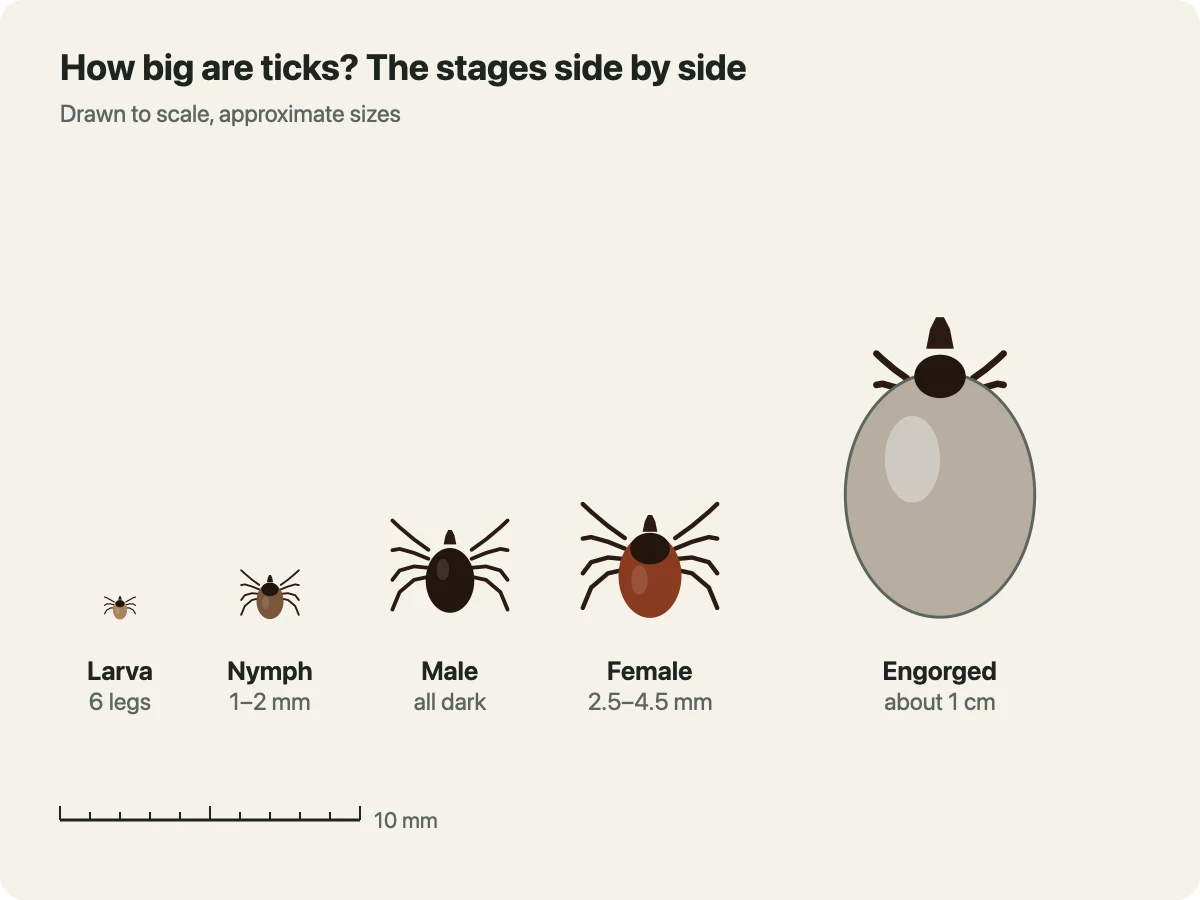
| Stage | Size unfed | Legs | Typical look |
|---|---|---|---|
| Larva | smaller still than a nymph | 6 | barely recognisable as a tick with the naked eye |
| Nymph | 1–2 mm | 8 | like a poppy seed or a freckle |
| Male | 2.5–4.5 mm | 8 | uniformly dark, because the shield covers the whole body |
| Female | 2.5–4.5 mm | 8 | red-brown abdomen, dark shield at the front |
| Female, engorged | about 1 cm | 8 | swollen and roundish, the legs look tiny |
The sizes for adult ticks come from the public health office of the city of Oberhausen. According to its fact sheet, a female takes up to 200 times its body weight in blood. Germany's Federal Environment Agency describes engorged ticks as growing "up to the size of a gooseberry". How to tell the stages apart in more detail is covered in "Tick larva, nymph or adult?".
What colour are ticks?
That depends on which tick you are looking at and how much it has already fed:
- Red-brown with a black front: a female castor bean tick, the most common find.
- All dark to black: often a male castor bean tick. Its shield covers the whole body. According to the Oberhausen health office, males usually do not feed, so they stay flat.
- Grey, grey-blue or pale and swollen: an engorged tick. The stretched abdomen looks lighter, while the shield stays small and dark at the front.
- With a pale, marbled pattern on the back: more likely an ornate dog tick.
- Very large, with yellow-and-brown striped legs: a Hyalomma tick. According to the Federal Environment Agency, it is 1 to 2 centimetres long and easy to tell from other species by these legs. Finds in Germany have so far been isolated.
Which species occur in Germany and what they can transmit is covered in "Tick species in Germany".
What does a tick look like in the skin?
Once a tick has attached, you only see its body. The mouthparts are in the skin, the body sticks out at an angle, and if you look closely you can see the legs at the sides. The smaller the tick, the more likely you are to take it for a dark dot, a small mole or a bit of dirt. Typical spots are areas of thin, warm skin such as the armpits, the backs of the knees or the groin.
Not feeling the bite is no accident: according to the Oberhausen health office, tick saliva contains a numbing substance. That is why ticks are often only discovered in the shower or when putting on cream. How to classify a dark dot with confidence is explained in "Tick or mole?", how to tell it from other bites in "Tick bite or mosquito bite?".
Why looking alone often isn't enough
A nymph of just over a millimetre has hardly any contrast on tanned skin, among freckles or under hair. But a dark tick on lighter skin can be reversed: invert the image and the dark dot turns bright and stands out. How the trick works is explained in "Finding ticks with your phone". If you find one, remove it as early as possible; instructions are in "How to remove a tick properly".
Make small ticks visible: TickSpot inverts the camera image — free, no sign-up.
Start the tick checkFrequently asked questions
What does a tick look like?
Oval, flat and only a few millimetres long, with eight legs on the front half of the body, a hard, dark shield on its back and tiny mouthparts at the front. The common female castor bean tick has a red-brown abdomen with a black front.
What do ticks look like when they are small?
Like a dark dot. Unfed nymphs are only one to two millimetres long and easily mistaken for a poppy seed, a freckle or a small mole. Larvae are smaller still and have six legs instead of eight.
Are there black ticks?
Yes. An all-dark, flat tick is often a male castor bean tick, because in males the dark shield covers the whole body. Females, by contrast, have a red-brown abdomen with a dark shield only at the front.
What does an engorged tick look like?
Swollen, roundish and noticeably lighter, often grey or grey-blue, with a small dark shield at the front and legs that look tiny next to the body. A female can swell to around one centimetre.
What does a tick look like in the skin?
You only see the body, sticking out of the skin at an angle. The mouthparts are in the skin, and the legs can be seen at the sides. A mole, by contrast, lies flat in the skin and has no legs.
Sources
- German Federal Environment Agency (UBA): Hard ticks (shield in males and females, legs per stage, engorged size, Hyalomma; in German)
- ECDC: Factsheet Ixodes ricinus (shield, pairs of legs, no eyes, sensory organ)
- Public health office of the city of Oberhausen: fact sheet on the castor bean tick (July 2019; size, blood intake, males, numbing saliva; in German)
Note: This article helps you identify ticks and does not replace medical advice. If you have symptoms after a tick bite, a ring-shaped rash or a fever, seek medical advice.